Custom-made boat: Jadran 590
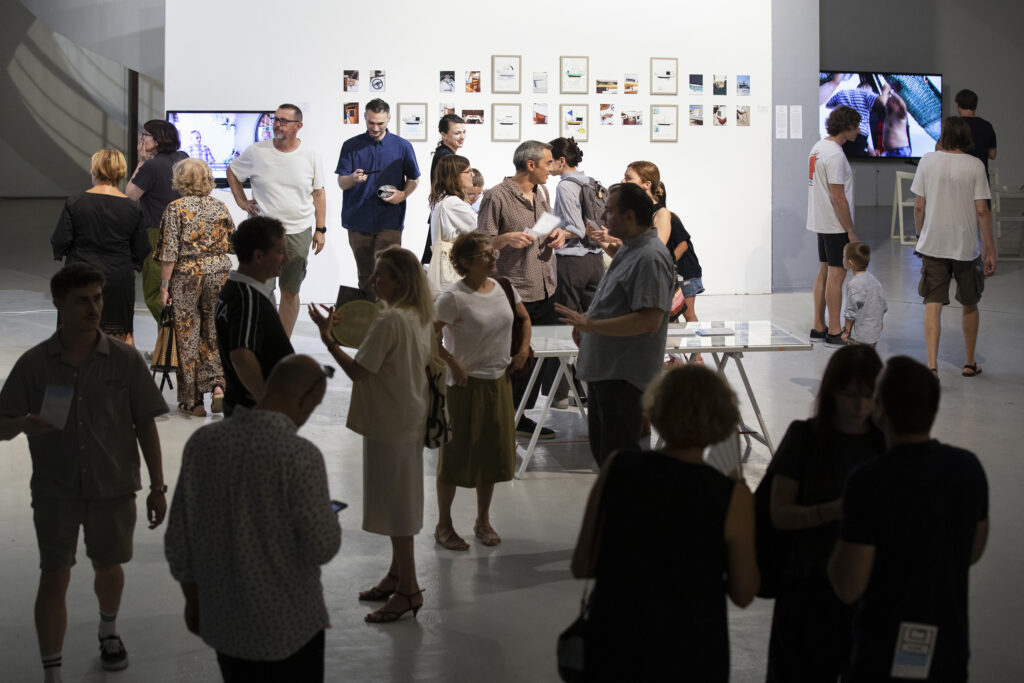
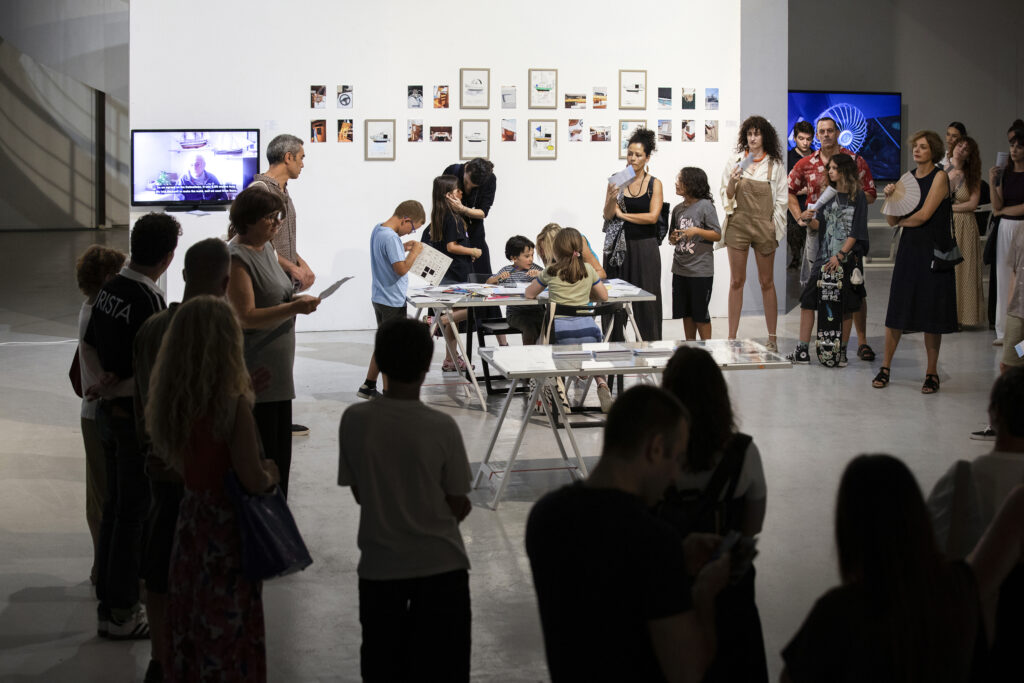
As part of the group international exhibition “Overtourism”, which opened on July 9th in the Gallery of the MKC Youth Centre in Split, the research part of the project “Custom-made boat: Jadran 590” was presented.
The archetypal image of small Adriatic communal marinas is unimaginable without rows of small fiberglass boats: mass-produced models from the 1970s and 1980s that their owners adapted over the years to their own needs and ways of life through a range of DIY modifications and vernacular design. Today, these colorful little boats, once used for recreational fishing and swimming, are increasingly giving way to large, fast, fully equipped boats by foreign manufacturers, most often intended for tourism. Their owners rarely work on their boats themselves, and even more rarely spend their free time in the small marinas. The places that shaped the identity of coastal communities for decades are disappearing, and with them the local skills that were developed and passed down over time.
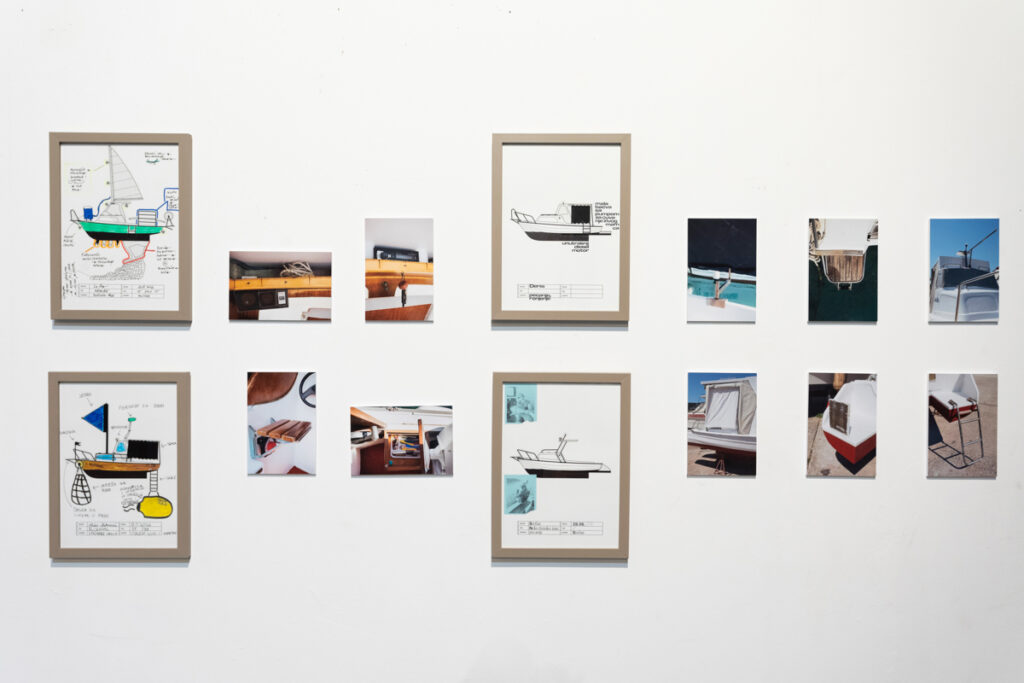
These boats were most often bought in a basic kit version, then adapted at home, often in the yards of family and weekend houses, and finished in marinas. As a result, countless versions of each model exist today, each bearing the specific touch of its owner and reflecting personal needs, financial means, and manual skills. One set of modifications related to speed and stability, another to protection and safety, and a third to comfort and ease. Speed and stability were achieved through the installation of spoilers, platforms at the stern, or smaller extensions at the bow. Safety was improved with metal handrails and bowsprits that made boarding easier. Comfort was created through awnings for shade and rain, windows that kept out spray and harsh sun, and improvised kitchens, folding tables, and sleeping arrangements.
In a story by Miljenko Smoje, the famous chronicler of Split and Dalmatia, adapted into a television film Od petka do petka (From Friday to Friday) by Antun Vrdoljak in 1985, the protagonist, played by Boris Dvornik, impatiently waits for Friday: the day when he steps into his small boat and sets off on a weekend journey across the sea and islands. The đita (a Dalmatian term for a short trip, usually by sea) represents liberation for him, a departure from city life and an entry into the freedom of the sea. The đita emerged from the popularity of fiberglass boats, but also from the marinas that opened the coast to small boats, and the Adriatic to people looking for sport and leisure.
As fiberglass boat construction grew, a number of small marinas were built with support from local governments and businesses, and the voluntary labor of coastal residents themselves. Through networks of knowledge exchange, these marinas became micro-communities of resilience, places where skills were developed and preserved over decades. Knowledge about fiberglass initially came out of the first factories working with the material, and then spread gradually through the community marinas of the Adriatic.
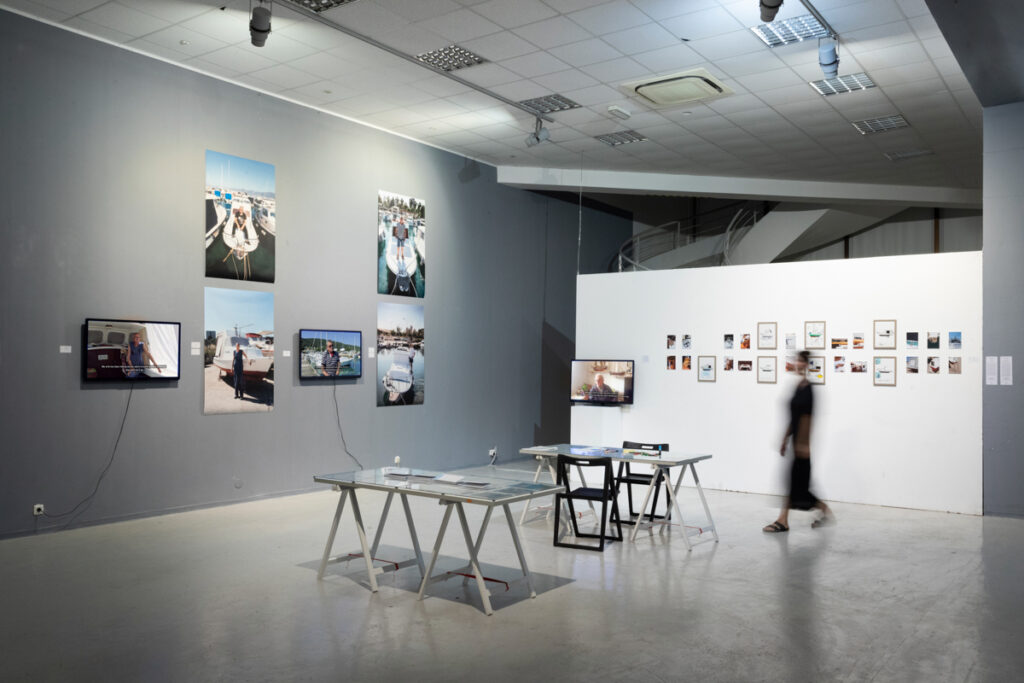
The exhibition traces this culture through interviews and photographs of owners and their boats, documentation of DIY interventions, film fragments, manufacturers’ advertisements, a timeline of small boat development, and a participatory space. If you have your own story, photographs, or documents that you would like to share with us, please contact us at interakcije@umas.hr.
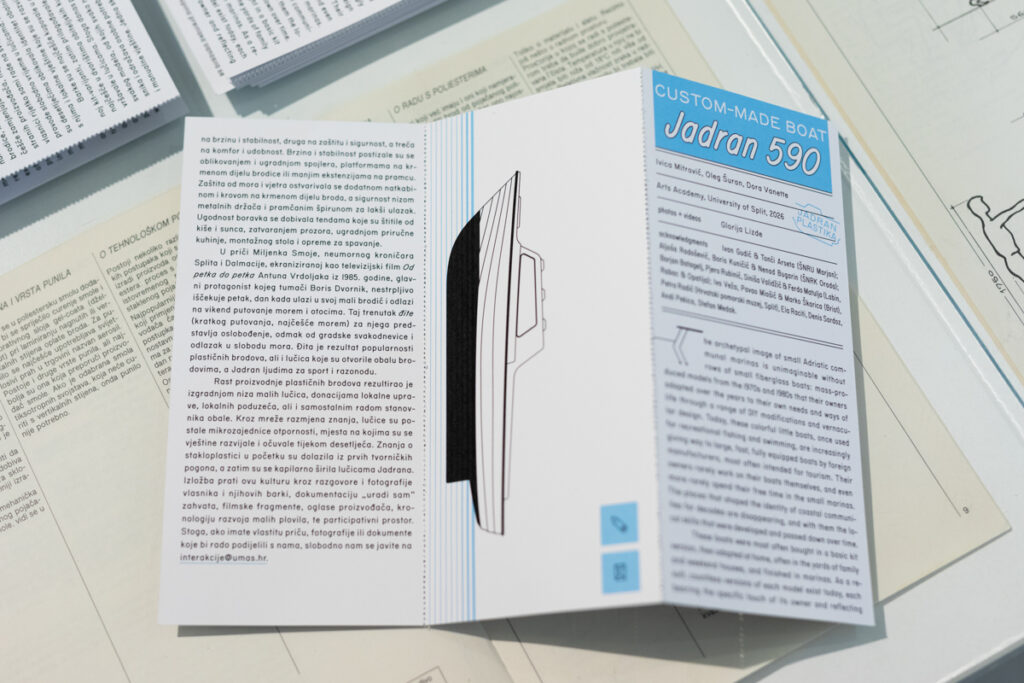
- Custom-made boat: Jadran 590
- Ivica Mitrović, Oleg Šuran, Dora Vanette
Arts Academy, University of Split, 2026 - Photos + videos:
- Glorija Lizde
- Acknowledgments:
- Ivan Gudić & Tonći Arseta (ŠNRU Marjan); Aljoša Radošević, Boris Kuničić & Nenad Bugarin (ŠNRK Orada); Borjan Batagelj, Pjero Rubinić, Siniša Validžić & Ferdo Matulja (Labin, Rabac & Opatija); Ivo Veža, Pavao Miošić & Marko Škarica (Brist), Petra Radić (Hrvatski pomorski muzej, Split), Ela Raciti, Denis Sardoz, Andi Pekica, Stefan Medak; Hrvatski državni arhiv – Hrvatska kinoteka, Antun Vrdoljak.
The project is produced at the Arts Academy, University of Split, as part of the international group exhibition “Overtourism” and was supported by funds from the Ministry of Culture and Media of the Republic of Croatia, the City of Split, and the Stamps School of Art & Design Ann Arbor, Michigan. Exhibition photos by Glorija Lizde and Žaklina Antonijević.
VIDEO (10:52)
Tonći Arseta (Jugoplastika Gradac 580, ŠNRU Marjan)
Aljoša Radošević (Kvarnerplastika Istranka, ŠNRK Orada)
VIDEO (11:08)
Ivan Gudić (Kvarnerplastika Dalmatinka, ŠNRU Marjan)
Boris Kuničić (Jugoplastika Gradac 580, ŠNRK Orada)
VIDEO (11:25)
Pjero Rubinić (Director of development and technical director of Kvarnerplastika [Raša and Labin], 1970s and 1980s)
Pavao Miošić and Ivo Veža (Marušić shipyard [Brist], from the late 1960s to the late 2010s)
VIDEO (9:11)
Od petka do petka / From Friday to Friday, segments, (Dalmacija film, Split, 1985)
Screenplay: Miljenko Smoje
Directed by: Antun Vrdoljak
Starring: Boris Dvornik
PHOTO (digital print, 90×135cm)
Aljoša Radošević, Kvarnerplastika Istranka, 4.90 m, 1974 (year the first model was produced)
PHOTO (digital print, 90×135cm)
Ivan Gudić, Kvarnerplastika Dalmatinka, 5.90 m, 1976 (year the first model was produced)
PHOTO (digital print, 90×135cm)
Tonći Arseta, Jugoplastika Gradac 580 / Marušić Pasara 5.80, 5.80 m, 1978 (year the first model was produced)
PHOTO (digital print, 90×135cm)
Boris Kuničić, Jugoplastika Gradac 580 / Marušić Pasara 5.80, 5.80 m, 1978 (year the first model was produced)
PHOTO SERIES (20 x digital print, kapafix, 12×18cm)
Modifications and improvements to the Istranka, Dalmatinka, and Gradac boats (Tonći Arseta, Aljoša Radošević, Ivan Gudić, and Boris Kuničić).
COLLAGES AND DRAWINGS (various contributors) (7 x mixed media, 21×30cm)
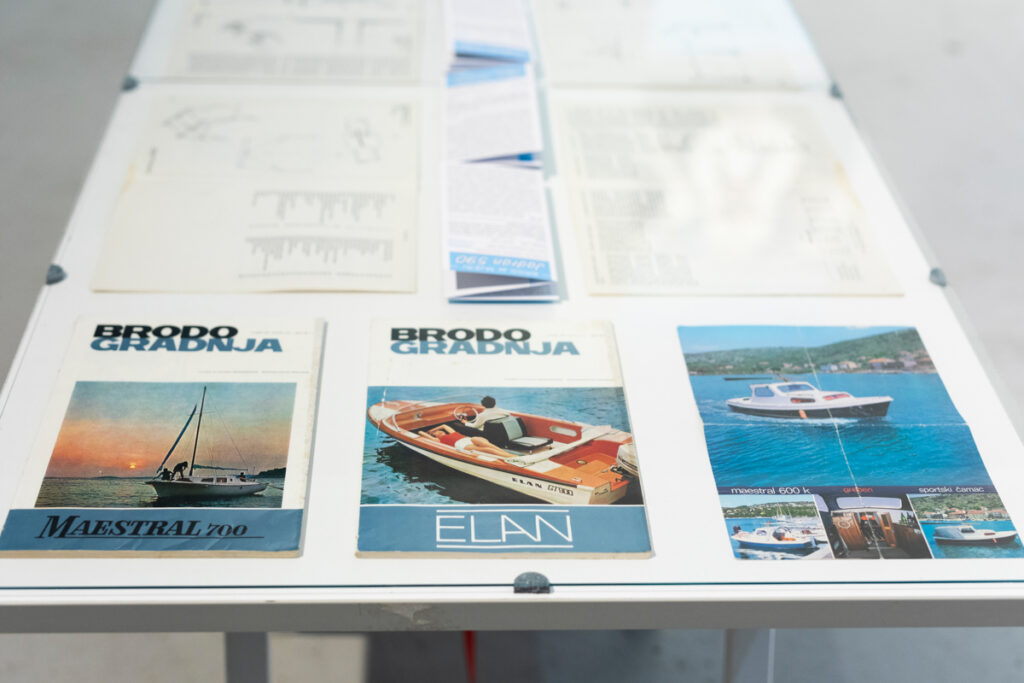
DISPLAY CASE
Selection of magazines, advertisements, and books related to small fiberglass boats from the 1970s and 1980s.
DISPLAY CASE
Diagram of selection of fiberglass boat models produced in Yugoslavia in the 1970s and 1980s.
TABLE
Workspace for bricolage and free drawings of customized boats — imaginations how would be used it in the future.